Posts

Showing posts with the label PSSTCHOANALYTIC TALES

"A LONG DISTANCE VOYAGER"

Image
The patient, on the couch. The analyst behind seated in a chair. DOCTOR: First let's introduce ourselves. What is your name? PATIENT: Leonard DOCTOR: Pleased to meet you, Leonard. I am Doctor Edward Scripture. The two police officers who have brought you have told me they found you wandering naked in Manhattan PATIENT: The thing is that to get into the machine, you have to get undressed DOCTOR: Aaah, I understand. The machine PATIENT: I mean the time machine, doctor. I explained it to the officers, but they didn't want to believe me DOCTOR: Have you invented a time machine? PATIENT: Not me. The NASA DOCTOR: Who is Nasa? A friend of yours? PATIENT: No. Of course, you can not know because... in what year are we? DOCTOR: Don't you remember the year you live? PATIENT: It's just that I come from the future, doctor. From the year 2034 DOCTOR: Oh, sure PATIENT: And now we must be in the year ... DOCTOR: 1934 PATIENT: Exactly. We programmed the machine to go ba...

"THE SEXY LAMP"

Image
The patient, on the couch. The analyst behind seated in a chair. PATIENT: Why do you insist on contradicting me, doctor? I tell you that my husband cheats on me! DOCTOR: But you have no proof PATIENT: And the floor lamp in the dining room? DOCTOR: For goodness' sake! We're back with the lamp! PATIENT: He bought her without consulting me! DOCTOR: Because he liked it. But that does not make him an adulterer PATIENT: That lamp is full of curves, doctor! DOCTOR: It's an Art Deco lamp. Art Deco is a curvilinear style. Your husband doesn’t cheat on you with that lamp. You have to get rid of that absurd idea PATIENT: What if I tell you I've seen him embracing her? DOCTOR: Embracing the lamp? PATIENT: The other night I woke up and he wasn’t by my side in bed. I went stealthily to the dining room and there he was, embracing her and whispering sweet nothings in her ear. What do you have to say to that, doctor? DOCTOR: (Perplexed) Did he whisper in the lamp's ear?...

"HE SEES DEAD PEOPLE SOMETIMES"

Image
The patient, on the couch. The doctor behind seated in a chair. PATIENT: Sometimes I see dead people DOCTOR: I beg your pardon PATIENT: There's a dead man right here DOCTOR: In this room? PATIENT: He's watching us DOCTOR: Oh, then, do you mean a spirit? PATIENT: Did you think I was referring to a cadaver? Do you hide a corpse, doctor? If so, don’t worry, I haven’t discovered it. DOCTOR: It’s a relief. So you see a dead man. Can you describe it to me? PATIENT: Medium stature. Striped suit. Shell glasses. A great head of hair. Sharp face ... Does it remind you of someone? DOCTOR: Freddy. A former patient. Is here? PATIENT: Not anymore. It is gone DOCTOR: Since when do you see dead people? PATIENT: Since I saw that light in the sky DOCTOR: Go on. Tell me about that light PATIENT: It got into my brain. Since then my life hasn't been the same again. I see dead people, and a rubber ducky DOCTOR: Are you seeing a rubber duck right now? PATIENT: No, not now. But i...

"A FREUD FULL OF NOSES"

Image
The patient, on the couch. The analyst behind seated in a chair. PATIENT: Did you meet Freud, Doctor? DOCTOR: Freud? No, I didn’t have the pleasure PATIENT: He must have been a great man DOCTOR: Yes, of course PATIENT: You know? Sometimes, when I'm lying on this couch, I imagine that I am in Freud's consulting room in Vienna DOCTOR: Really? PATIENT: Since you are silent and I can’t see you, I imagine you are Freud. Do you think Freud would have approved that? DOCTOR: What I think is that the time is running out and you're wasting your time talking about Freud PATIENT: So you think talking about Freud is a waste of time, huh? I feel that you don’t like Freud DOCTOR: I'm a Freudian psychoanalyst, so ... PATIENT: That has nothing to do with it. I have a light bulb factory and yet I don’t like Edison at all. Did you know that Edison stole patents? DOCTOR: Well, in this Freud resembled him a little. PATIENT: I beg your pardon? What have you said? DOCTOR: Well,...

"HE DOESN'T KNOW HER"

Image
The patient, on the couch. The analyst behind seated in a chair. PATIENT: Yes, yes, I did what you advised me. I asked for a divorce. Only she said no. DOCTOR: But you didn't insist PATIENT: Oh, you don't know her, doctor. When she says no, you better not ask again if you don't want to end up with a black eye DOCTOR: But it was not about asking. It was about claiming that you want a divorce PATIENT: Then it's for sure that I would have ended up with both black eyes. You don't know her, doctor DOCTOR: No, nor do I have the slightest interest after everything you have told me, frankly. How did you happen to fall in love with a woman like that? PATIENT: Oh, I was never in love with her, doctor. It was an arranged marriage. I had no other choice DOCTOR: But you knew her as a child. You knew what her temperament was. I guess at least you would show some opposition when her parents announced the arrangement. PATIENT: No, no, it wasn't her parents, nor mine, ...

"HE PULLED AND PULLED..."

Image
The patient, on the couch. The analyst behind seated in a chair. PATIENT: I pulled and pulled, and the elephant didn't move. Doctor Hoch, have you ever pulled an elephant? DOCTOR: What? No, no PATIENT: Then you can't imagine how strong those beasts are DOCTOR: I didn't know they sold elephants at Macy's. The advertising says they sell everything, but ... PATIENT: What do you say? Elephants at Macy's? DOCTOR: I thought you told me you were a dependent at Macy's PATIENT: Affirmative. Section of shoes for men DOCTOR: So you are not in the elephant section PATIENT: There's no elephant section at Macy's. Do you want to buy an elephant? I don't recommend it, Dr. Hoch. You can't imagine how strong these animals are DOCTOR: Yes, yes, I can imagine it. I have seen illustrations of elephants. I even saw a movie once ... PATIENT: Ah, but it's not the same as having personal experience. I pulled and pulled and the elephant did not ...

“NOBODY SAID IT WAS A CINCH!”

Image
To illustrate the technique of free association, which is the basic technique of Psychoanalysis, I will transcribe below the session that took place on October 12, 1924 in the office of Edward Scripture, charter member of the New York Psychoanalytic Society. Scripture has just received a new patient in his consulting room. After the appropriate greetings , each one occupies its respective place in the psychoanalytic stage. Scripture gives the patient instructions on how to proceed with the technique of free association of ideas . It is, he says, a kind of long chain that leads to the past and in which he, Scripture, is going to string the first link: “ I will mention a word, and immediately you will respond with another word with which you relate it. Do you understand?” Patient: Yes Doctor: If I mention the word "vacation", what’s the first thing that comes to your mind? Patient: An aircraft carrier Doctor: Interesting. Have you spent a vacation on an aircraft carr...

"THE SECOND GENERATION"

Image
The so-called "second generation” of psychoanalysts was much better qualified than the first one. To begin with, they knew for sure what it was all about. The first one was a bit lost. Ferenczi, for example, initially believed that psychoanalys was a new type of dance. Ernest Jones was convinced that it was a card game and, well into the 20th century, he always carried a deck of cards in his pocket just in case. These early psychoanalysts had learned psychoanalysis haphazardly, in dribs and drabs so to speak. Their theoretical grounds depended to a large extent on the mood in which Freud had got out of bed in Vienna that morning. Besides, practice is everything in any therapeutic discipline. And before the Great War few people allowed themselves to be psychoanalyzed if it was not at gunpoint. Psychoanalysts of the first generation were like those hairdresser trainees who roam the streets in search of whatever head of hair he can get his hands on. In general, people prefer to place...

"THE SUPERIORITY COMPLEX"

Image
Nobody understood why, among all the wide spectrum of neuroses and complexes at his disposal, Michael Pea would have chosen precisely the superiority complex. He had no attribute that legitimately granted him the right to believe himself superior to others. He had all the defects that a human being can have and even some other. He was a liar, selfish, quarrelsome, cowardly (How can one be cowardly and quarrelsome at the same time? You had to know Pea to find out), lazy, stupid ... Well, why list them all? I have already said that there was no defect that he didn't have. And even those defects that can have a positive side, such as ambition for example, he lacked that side. That a guy like that had a superiority complex was something that didn't fit in anybody's head. Hence, when the brilliant psychoanalyst Edith Jacobson met Mr. Pea, she considered him a phenomenon worthy of study. Mrs. Jacobson had recently moved to Brooklyn with her family and Mr. Pea lived in the house n...

"A BIG MISTAKE"

Image
Jacob Rosenbloom and Samuel Tannenbaum, two of the charter members of the New York Psychoanalytic Society, were sitting in armchairs by the fireplace, commenting on a recent academic essay entitled "Psychoanalysis of a sheep", when suddenly Donald, the concierge, burst into the small room visibly agitated. "What's wrong, Don? You'd think you just saw a ghost." "Almost!” he said pointing to the door that led to the lobby. An elegantly dressed man walked into the parlor, handling gracefully his pearl-handled cane. "Kirby!" Exclaimed the two men in unison, leaping to their feet, "We thought you were dead!" Before proceeding, it must be explained that George H. Kirby was another of the charter members of the Society, but no news of him had been heard since he was buried with all the honors in the Green-Wood Cemetery in Brooklyn a week ago. "I don't suppose it’s occurred to you to resurrect, right?", Tannenbaum dared to say,...

"NEW YORK CITY IN THE NEUROTIC TWENTIES"

Image
In the Roaring Twenties, New York City was a hotbed of neurotics. There were neurotics of all kinds: obsessive-compulsive, compulsive-obsessive, hypochondriac, manic-depressive, depressive-manic, manic-compulsive, obsessive-depressive, depressive-obsessive, compulsive hoarding, hysterical... In short the whole spectrum of craziness. Then, there were the complexes. Some more than other, everyone was hung-up. Over weight, over height, over poor intelligence, over too much intelligence, over acne, over this or over that. The variety of complexes was infinite, it can not be enumerated. But the three-level podium was for the Oedipus complex (discovered by Freud); the Guilt complex (discovered by a child named Artie who, while ordering an old attic of his family, discovered it hidden among a pile of old clothes); and perhaps the favourite of every neurotic: the inferiority complex (discovered by Alfred Adler while wearing boots with artificial soles to look taller). The inferiority complex ...

"THE INFERIORITY COMPLEX"

Image
If we talk about one of the most popular complexes of all time (the inferiority complex), we must refer to a paradigmatic case that was analyzed by the very discoverer of this complex, Alfred Adler. Its protagonist was a young pianist from Hungary who we will call Sandor. Sandor's talent at the piano had been extolled by the most famous composers of his time. For example, the prolific composer of Broadway musicals Karl Massin ("The world is a giant egg", "I have a damned headache from loving you so much", "I was rich until I stopped being", "The potty of a mother") said of him that "I do not know another pianist who knows how to play with the ten fingers at the same time." (This praise contained a veiled criticism of his last musical’s pianist who was the producer’s protegé and who played the piano using a single finger and it was a while before he found the corresponding key.) Well, this young man of such promising future suffered ...

"HOMELESS"

Image
"What the hell am I doing?" Sigmund Freud wondered as he warmed himself in the heat of a bonfire next to a group of homeless in a dead end street in the New York neighborhood of Harlem. "I'm not a man of action, for God's sake. I am a psychoanalyst, the most sedentary profession that exists. And here I am with these niggers (Freud was not racist but he preferred to stay away from anyone who was not of his own race and, if possible, from his own tribe of Zebulun) fleeing from colleagues with an Oedipus complex." He expressed these thoughts aloud, which made him the target of the grim looks of his companions in disgrace. To ingratiate himself with them, he offered to psychoanalyse them for free, which he did with the help of an old mattress and a broken chair found in the trash. It turned out that the subconscious of those homeless men was much richer than that of any of the members of the European high society and bourgeoisie that Freud had analyzed. Startin...

"SAYING A KADDISH FOR FREUD"

Image
The next morning, Rank served as Freud's tour guide. He accompanied him through Manhattan highlighting the prodigious heights that reached the buildings, calling each one by name: the Singer Tower, the Empire State, the Flatiron, the Woolworth ... From all that looking up, Freud got stiff neck, being unable of lowering his head just as they crossed Times Square in the middle of the intense traffic. He woke up hours later in a hospital bed. His head hurt, but that (the doctor reassured him) was normal after a concussion. Then Freud remembered being hit by a vehicle. Soon he would be discharged, the doctor added, and he could leave with his friends. ¿His friends?Then Freud knew that Oedipus was waiting for him downstairs in the hall, no doubt plotting some other plan to eliminate him. Without the doctor having time to stop him, Freud sprang to his feet and ran like a bat out of hell. He ran down a long corridor avoiding all kinds of obstacles. In an elevator he discovered a solita...

"OEDIPUS STALKS"

Image
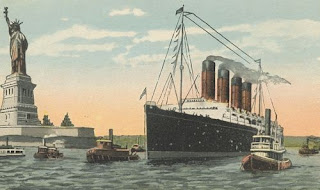
When Freud received the letter in which Rank told him the premonitory dream he had witnessed, he feared that after all Jung was right and there was a supernatural component in the human psyche. “That’s all we needed!” he thought. Since his breakup with the Vienna Psychoanalytic Society, Jung was also living in America. So Freud could not help thinking that maybe such supernatural component was only present there. So he decided to go to America and find out by himself. When, on his arrival in New York at midnight, Freud saw from the deck of the ship the Statue of Liberty with its illuminated torch, the Oedipus complex immediately came to his mind. Not the Oedipus Von Stroheim that had been the cause of his discrediting in Vienna but the authentic Oedipus: the one who had killed his father to marry his mother. The Statue of Liberty symbolized for him the mother for whom the Americans had get rid of their father Great Britain. Rank was waiting for him on the dock in the company of his pr...

"OTTO RANK AND THE MOBSTER"

Image
In the twenties, Psychoanalysis had much more prestige in America than in Vienna itself where it was conceived. In particular, the New York Psychoanalytic Society had so many members that it was said that half of New Yorkers were engaged in psychoanalysis and the other half attended their practice. However, most psychoanalysts lacked first-hand information about the theoretical bases and procedures to follow in psychoanalytic therapy. For example, the use of hypnosis was abused, and even the knowledge about it was incomplete: they knew how to induce the hypnotic state in the patient, but they were unaware of the way to get him out (which was used by unscrupulous politicians to guarantee the vote). When Freud learned of these shortcomings, commissioned Otto Rank to travel to New York with the mission of bringing order to the New York Psychoanalytic Society. Rank was fascinated by the skyscrapers. When he walked down the street he was always looking up, which several times was about to ...

"ON THE EVE OF THE GREAT WAR"

Image
Shortly after the Musikverein Golden Hall's incident, Freud said during the Wednesday meeting of the Vienna Psychoanalytic Society that lately he had the impression of being followed. Otto Rank expressed his fear that the Master was becoming paranoid. But, on behalf of the Society, he took it upon himself to check it. And it turned out that Freud was right: a patrol of hussars in their colorful uniform and on horseback followed him wherever he went. They even performed the ceremonial relief every three hours. This confirmed Freud's suspicions that psychoanalysis was now in the government’s spotlight. His disciples were in charge of safeguarding all the case histories of patients analyzed by Freud in the last decade. Taking advantage of the ceremonial relief of the patrol of hussars, they managed to sneak all the files out and bury them in the Schöpfl forest, where they remained hidden until, in the middle of the 20th century, a poisonous mushroom picker found them by chance and...

"THE CASE OF THE BUGLE-MAN"

Image
Sometimes Freud found himself in difficulties communicating with his patients. Deaf-mute people for example, or people who lost their speech as a result of trauma. In those cases, Freud turned to one of his most faithful disciples, Hanns Sachs, as he was an expert in non-verbal communication. Gesture or facial expression could reveal to Sachs the most recondite secrets of a patient's subconscious. For example, the way in which Mrs. Kilghorn smacked her husband revealed to Sachs the anger that this woman had accumulated against him over the years. In turn, the manner in which Mr. Kilghorn received the blows revealed the guilt he felt for allowing his wife to smack him for no reason without him resisting. The fact is that now Freud needed again his disciple's insight to interpret the non-verbal communication of his new patient. In Freud's extensive case history, this patient is called Bugle-Man, because of his almost exclusive means of communication. The Bugle-Man had lost h...