Posts

Showing posts with the label Society for Psychical Research

"PSYCHOTHERAPY"

Image
Spending a whole year gawking at the most amazing paranormal phenomena for a Harry Houdini to demonstrate that you have been sold a bill of goods, does not happen without your mental stability being affected to a greater or lesser degree. That is why after the unmasking of a false medium, four of the most prominent members of the Society for Psychical Research -Gurney, Barret, Lodge and Myers- were forced by the SPR Governing Board to attend the consultation of Ernest Jones, one of Sigmund Freud's English outstanding disciples. (Freud refused to treat them personally because he still resented the breakage of a guitar in his head during a séance). Ernest Jones was skeptical not only in relation to paranormal phenomena but also to phenomena as normal as birth (he was convinced that babies were found in a cabbage patch) or death (according to him, only fools died). He resolved to try group therapy with the four members of the SPR. They had to pass a ball made of rags to one another, ...

"THE SLEEPWALKERS"

Image
When Frederic W. H. Myers, prominent member of the Society for Psychical Research (SPR), read Mrs. Cassel's monograph "Paranormal Waters", where she gives an account of the paranormal activity that happens in the spas, he was fascinated by the variety and scope of the phenomena presented in the book. Eager to do the test himself, he arrange a fifteen-day stay at a famous English spa, but nothing remarkable happens to him (except the loss of all his pants, which he attribute to no paranormal power but to the incompetence of his valet). Frustrated, he arrange an interview with Mrs. Cassel herself at her home in Clermont. There he unleash his disappointment claiming that his stay at the spa has been the most boring fortnight of his life (with the possible exception of the fifteen days that he spent hidden in a barrel). Besides, as a consequence of spending so much time submerged in water, he has become all wrinkled like a raisin, not to mention the loss of all his pants that...

"A PARANORMAL LOVE STORY"

Image
The truth is that during the question time that followed the Friday afternoon conference at the SPR headquarters, the questions of the “silly genre” abounded. "If ghosts do not occupy space, how many ghosts fit in a tylbury?" "Telekinesis could be manufactured and put on the market at a low price?" "Clairvoyance is in colors or in black and white?”. This kind of silly things. Once, however, a question apparently as silly as the ones I just mentioned was asked, but that question led several members of the Society for Psychical Research to undertake a serious investigation. The question was: "Can anyone recognize a person he has never seen?". And indeed, if that had been all, the question would have gone to swell the list of stupidities that were said in those long evening sessions open to the public. But when, soon thereafter, the man who formulated it put the question in its context, the members of the SPR were intrigued and decided to investigate the...

"THE WEIRD BOOK"

Image
In 1891, a weird book circulated through the black market of ancient manuscripts. Weird is the exact adjective to describe it. Everything in it was weird: the title, the illustrations, the text ... Even the alphabet with which it was written was weird. Nobody understood anything about it, not a single word, not a single illustration (except one that Osborne interpreted as the figure of a dromedary upside down and without legs, but that was only a conjecture). That book was a complete enigma. The linguists who examined it ruled that it was either the work of a madman, or the work of a sane man who pretended to be mad in order to travel for free to Stockholm, or a madman who feigned sanity to pose as a kangaroo, or someone in his pyjamas who could not wait to urinate. That's how strange this book was! It was also said that it was cursed and that everyone who came into contact with it either caught his fingers with a door or received a reprimand at work. However, Gurney was not afraid...

"FAIRIES"

Image
Fairies were another of the Society for Psychical Research's workhorses. Among its members there were supporters of its existence, there were supporters of its nonexistence and there was a third group led by George Philimore who was not a supporter of either one or the other. When this third group were asked for their opinion about it, they crouched down and held their breath with their fists closed until their faces turned a deep purple color. When he was low in morale, Crookes thought that maybe they were right. But when he was in a good mood, he believed firmly in the existence of fairies, although he did not dare to put it in writing. It must be said that on those occasions of euphoria, Crookes not only believed in fairies and elves but also in the existence of Santa Claus, the Tooth Fairy and even a Mr. Swosky who supposedly ruled the world clandestinely and tortuous from an opium den of Spitalfields. Crookes was a most fickle man. He could beg you to offer him a Scotch whiske...

"DO FAIRIES EXIST?"

Image
On a rainy winter evening, the senior members of the Society for Psychical Research were gathered around the fireplace in the comfortable living room of the SPR headquarters. While each one lit his pipe, Sir Henry Sidgwick offered to tell them an intriguing story that he was told the last summer when he was with his family in Wales. And it was told to him as a true story. Everyone nodded and listened with interest: In a small Welsh village lived a married couple very well matched in everything except in their beliefs about life after death, where they both diverged. Mrs. Robinson believed in the Afterlife, Mr. Robinson in the Beforedeath. The village was equally divided with respect to an old woman who lived in a cabin on the outskirts of the town. Some said that she had paranormal faculties and the others claimed that she had “disturbed” faculties. Of course, Mr. Robinson was aligned with the latter and Mrs. Robinson with the first. For her part, the old woman was aligned with those ...

"THE MYSTERY OF THE CLOCK CUCKOO""

Image
Every Friday evening the Society for Psychical Research opened its doors to the public to attend the weekly talk given by one of its members. As always, the secretary kept records of everything that was said and everything that happened in those talks. In the end, there was a question time that sometimes lasted until well into the night. The minutes of March 15, 1887, are an example of how embarrassing this weekly contact with the general public could be. That evening the talk was given by Sir William Barret who expanded on the theme of "Apparitions" (without further details: that was the title of the speech). Well, when question time came, one of the attendees took the floor to say: "You have talked about apparitions, but what about disappearances?" There was a murmur of confusion when the man stood up lifting a cuckoo clock. Yes, yes, you have read well: a cuckoo clock. "It's been six days since the clock cuckoo of this cuckoo clock has disappeared and, a...

"THE TEASPOON BENDER AND THE MAGICIAN"

Image
Aaron Koperman, the famous teaspoon bender, received an invitation from the Society for Psychical Research to demonstrate his skills in a controlled environment. The invitation was accepted, and the night before the experiment, H. G. Myers surreptitiously burst into the large kitchen of the SPR headquarters in order to stock up on teaspoons. When the next morning Koperman arrived, Myers himself accompanied him to the laboratory where the experiment was to take place. For the control of it, had been invited Dominick Cilliano, a famous illusionist who had a successful magic show in the West End. Under the watchful eyes of Cilliano and a select group of SPR members, Koperman grabbed one of the silver teaspoons and, taking it gently with two fingers, stared at it with a frowning face and, leaning towards it, he said something to the spoon in a low voice (according to Crookes, who sat next to him, it had been a threat). The point is that immediately the spoon bent as if it were made of butt...

"MYSTERIES OF THE LONDON ZOO"

Image
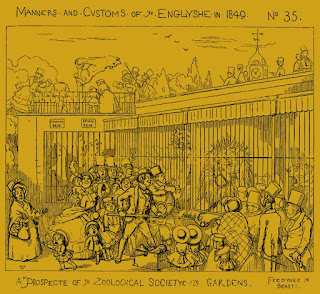
A nice summer morning during breakfast, Gurney proposed to the junior members of the Society for Psychical Research to spend the day at the zoo. Everyone agreed except Roger Davenport, who does not know if he will have enough courage to face that challenge. Gurney reassures him that the animals are caged. But it turns out that what scares Davenport are precisely the cages, since when he was a child he was locked up by accident in the chicken shed. In the end they manage to convince him. For a researcher of the paranormal, facing situations out of the ordinary, however normal, give him a sense of unease. That's why as soon as they entered the London Zoo, Roger Davenport and his colleagues began to see paranormal phenomena everywhere. Cavendish, who remained ecstatic contemplating the neck of the giraffe, proclaimed that such unusual elongation would be a good topic of study. As a man of the world who had had occasion to see exotic animals in their own habitat, Gurney explained him ...

"THE COWARD VAMPIRE" (a paranormal tale)

Image
In the living room of the “Society for Psychical Research”, Mr. Henry Sidgwick was reading “The Times” by the fireplace. Sitting in front of him, Sir Martin Osborne had started nodding during the reading of a chemistry book. “Good heavens!” suddenly Sidgwick exclaimed, causing his friend to wake up and the book to fall to the ground. “What happen?”, inquired the eminent chemist. His companion read aloud an article about a macabre event occurred last night in Highgate Cemetery. A pair of body snatchers had unearthed a coffin from which a vampire had emerged. Osborne let out a loud laugh. He did not believe in vampires nor body snatchers nor coffins nor cemeteries. He only believed in organic chemistry. He got up, picked up his book, his cane, and said goodbye. Arriving at his house in North London, he was still thinking about that bizarre story his friend had told him. "It seems incredible that there are such credible people," he said to himself and giggled. At that moment he...

"MUMMIES BECOME THE TREND"

Image
In the Victorian era there was a great passion for everything that came from ancient Egypt. The interest went from the mysterious pyramids to the mummies through the mortal concoction that ended the life of Cleopatra and whose formula (found in excavations in Cairo) was proposed in a parliamentary session by Sir Quincey Fitzpatrick as the national drink instead of tea, whose bitter taste he personally detested. Especially mummies exercised a powerful fascination over the English imagination of that time. In every castle or mansion of the high society, old-fashioned medieval armor had been cornered in the attic in favor of an imposing Egyptian mummy. In the market there were so many mummies for sale that one did not know what to do with them, and all kinds of products made with mummy powder began to be commercialized: medicines, aphrodisiacs, beauty ointments and it was even marketed as an exotic spice for season the most exquisite dishes. Naturally, the Society for Psychical Researc...

"THE DEAD WISH GOOD NIGHT" (a paranormal tale)

Image
One day, during breakfast, Sir William Barret announced that he wanted to test his mediumistic gifts. Henry Sidgwick asked him what was he based on to suppose that he possessed such gifts. He replied that when he was ten years old, he once dreamed of his father and when he woke up he found his father in the family room sitting in his favorite chair reading “The Times”. Then, he suddenly lowered the newspaper and, pointing to his son with his finger, asked "Have you read the Bible?". This story had a strong emotional impact on the members of the SPR, until Barret clarified that at that time his father still lived and resided in the old house in Sussex with the rest of the family. Still, Barret was so insistent that Sidgwick ended up agreeing to the whim of his friend and organized a séance for that same evening. In the early afternoon, a wagon stopped in front of the entrance to the SPR headquarters and two large wooden boxes were moved to the living room where the séance was ...

"THE SIXTH SENSE" (a paranormal tale)

Image
Another of the warhorse issues of the Society for Psychical Research was what in the Victorian era was known as “sixth sense” and today is called Extrasensory Perception (ESP). For a whole day, through the laboratories of the SPR headquarters in West Kensington, dozens of volunteers paraded, with the help of whom it was intended to establish the frequency with which the “sixth sense” manifested among the population in general. They were given a choice of four alternatives: a circle, a square, a triangle and a dancer named Claire Smithson who was then triumphing at a music hall of the West End. The subjects had to figure out which of these four alternatives Frederic Myers was thinking. During the entire duration of the experiment, Myers remained in a closed room at the other end of the building. The problem is that he turned out to be always thinking about the same alternative (I will not reveal which one of them), which to some extent discredited the statistical results of the experime...

"THE TALENTED ALIEN" (a paranormal tale)

Image
I will tell you how the Society for Psychical Research first heard about what we call today flying saucers or Unidentified Flying Objects (UFO), but in 1890 (when this story is placed) they still did not have a name. (The testimonies referred to them as "that"). It turns out that in Burnley, County of Lancashire, lived a man capable of interpreting the song "If Ever I Cease to Love" with the laces of his shoes. For Sir Henry Sidgwick, this was an unprecedented paranormal phenomenon. As Sidgwick was the president of the Society nobody dared to contradict him, and that is how an expedition was organized to the county of Lancashire. (For the musician in question it was impossible to travel since he lacked other shoes than those he used to make music and they went out of tune if he walked with them.) Early in the morning, the four members chosen for the mission embarked on a stagecoach surrounded by the expressions of affection and gratitude from the rest of the SPR mem...

"THE SWAYING SHADOW" (a paranormal tale)

Image
William Barret came and went constantly from London to Brighton. Not for work reasons. Nor for pleasure. In fact, there was no reason whatsoever, simply he had that compulsion, he could not help it. One evening, in an after-dinner conversation he mentioned that, on each of his round trips, he sighted a very tall figure standing at the edge of the road saying goodbye with his hand as if in slow motion and with a swing of his whole body. This figure managed to stay always in the shade, so that Barret could never see its face. Of course it could not be someone known to him, since Barret did not know anyone who measured three meters high. That was the approximate height of the figure according to his calculations. Also, it did not do any other gesture, just that swaying saying goodbye with its arm up. Gurney said that this was extremely rare and that it deserved to be investigated. But all the other members started to cough and make excuses, so he was left alone with his proposal. Gurney ...

"CONTROVERSIES"

Image
Professor Stewart, distinguished member of the SPR, did not believe in coincidences. Gurney used to prod him, commenting on some coincidence that had happened to him. Then Stewart burst into a loud laugh and mocked him for being so gullible. “There is no need to believe in coincidences to explain the phenomena of the universe”, he used to say, “things are much simpler". According to him, everything obeyed a perfectly structured secret plan and in that plan there was no room for the slightest error. Once, he received a bill addressed to another person and he paid without question. Since then, other people's bills never stopped arriving. But he could afford it, he was a rich man. The controversy over Destiny versus Chance was one of the highlights of all the after-dinner conversations in the Society for Psychical Research. William James believed that coincidences existed but only by chance. Frederic Myers believed that such statement was a “supreme nonsense” and that James had a...

"THE ENIGMA OF THE VANISHING GIRL"

Image
In the West Kensington spacious loft where the SPR files are gathering dust on the shelves, I discovered under old canvases a drawer full of folders that had been torn from their filing cabinet. It was, I think, a kind of graveyard where the cases over which someone intended to draw a thick veil finished their days. Among these, I found the case that I am going to refer now. Its protagonist was a young girl of the London high society. One day the president of the Society for Psychical Research received the visit of an elegant woman who requested the services of the SPR to find her daughter. Mr. Sidgwick kindly informed her that this was not a detective agency but a scientific institution dedicated to the investigation of parapsychology and paranormal phenomena. The woman said she was aware and that was precisely why she had resort to them. Then she explained that she thought his daughter had evaporated, literally. A few minutes before her disappearance, she had left her daughter absorb...

"SIGMUND FREUD VERSUS SPR"

Image
It was his interest in sleepwalking that put the father of Psychoanalysis Sigmund Freud in relation with the Society for Psychical Research. One night Sir William Barrett was walking on the sidewalk after leaving a pub in Soho when he crashed into a man who walked with his eyes closed and arms outstretched. The man woke up at that moment, and a few meters behind him Barret heard a voice grumbling and complaining. It was Freud, who was following one of his patients in order to discover where he went every night after leaving home in a state of somnambulism.   At the advice of Freud, the man’s wife did not dare to stop him. And precisely that night Freud had decided to find out where his patient was going every night. (Later it was discovered that his destination was the same tavern that Barret frequented and that sleepwalking was just a stratagem of the man to escape from home at night without his wife preventing him from doing so.) Barret apologized and offered Freud his card wit...

"THE RISKS OF SKEPTICISM"

Image
Misinformed people tend to believe that in the Society for Psychical Research everybody was very naïve and willing to believe in anything. That you could tell them that you were a vampire about to transform into a bat and they ran to close the windows for fear that you would fly away. And well, I will not deny that there was someone who was very credulous (talking about vampires, a certain member wore several strings of garlic as necklaces). But it was the exception. As a rule, they were eminent personalities from various fields of science with a high degree of skepticism. There were even one who carried his skepticism to the point of fanaticism, which caused him to end up very badly. I will omit his name for delicacy and call him Mr. Skeptic. When they tested the mediums with whom they collaborated, the members of the Society set traps to find out if they were being cheated. But Mr. Skeptic took this tactic to the extreme. At the end of the summer season of 1879, Mr. Skeptic returned ...

"THE BILOCATED MAYOR"

Image
The issue of bilocation (the supernatural presence of a person in two places at the same time) drove the “Society for Psychical Research” nuts. For example, in Edinburgh there was one George Nottage who, without ever leaving that city, served as mayor of London for two terms. Sir Sidgwick was skeptical and thought it was a case of twins. William Barret advocated another rational explanation: according to him, it was a single individual who constantly came and went from one city to another. Myers, on the other hand, considered it a genuine case of bilocation, albeit not entirely perfect since, unlike the George Nottage of London, the one in Edinburgh used to wear a Tyrolean hat. This case generated a lot of controversy among the general public since the citizens of Edinburgh ended up electing their Nottage as mayor of the city coinciding with the London Nottage mandate. In a convention of British mayors, somehow the two Nottages managed to avoid each other, so nobody ever got to see the...